.png)
Quick answer: Building a house in Ireland in 2026 costs €1,800 to €3,000 per square metre for construction, plus 20 to 30 percent on top for fees, connections, contributions and landscaping. A typical 150 sqm family home at mid-range specification totals €445,000 to €510,000 all-in before the site. The two decisions that most protect your budget are a simple compact design and a fixed-price contract on a short programme.
"How much will it cost to build?" is the first question every future homeowner asks, and the one that gets the least straight answers. Build costs in Ireland have risen substantially over the past five years, and even rebuild costs tracked by the Society of Chartered Surveyors Ireland (SCSI) have continued climbing year on year.
Here's the straight answer for 2026, with a full worked example, the costs everyone forgets, and the honest truth about the "cheapest way to build a house in Ireland".
How much does it cost per square metre to build in Ireland?
In 2026, building a new house in Ireland typically costs between €1,800 and €3,000 per square metre, all-in. Where you land in that range depends mostly on specification and location.
A basic spec (€1,700 to €2,000 per sqm) gets standard finishes and minimum-compliance energy performance; this band is increasingly rare, as NZEB requirements push every new home toward higher spec. A mid-range spec (€1,900 to €2,800 per sqm) is where most quality self-builds land: good kitchens and bathrooms, high insulation, heat pump, A-rated performance. A high-end spec (€2,800 to €3,500-plus per sqm) covers premium finishes, complex architectural forms and extensive glazing.
Dublin and surrounding counties price at the top of each band; much of the rest of the country sits toward the middle and lower ends.
For common house sizes at mid-range spec, expect roughly: a 100 sqm 2-to-3-bed at €190,000 to €280,000; a 150 sqm 3-to-4-bed at €285,000 to €420,000; a 200 sqm 4-to-5-bed at €380,000 to €560,000. These figures exclude the site itself.
Worked example: a 150 sqm family home
Take a typical 150 sqm, 4-bed detached home at mid-range spec on a reasonable rural site.
Construction (structure, roof, windows, first and second fix, finishes) at around €2,200 per sqm comes to €330,000. Site works, foundations, and drainage add €25,000 to €40,000. Utility connections (ESB, water, wastewater treatment if no sewer) add €12,000 to €25,000. Professional fees, covering design, engineering, and the Assigned Certifier under BCAR and BER, run 8 to 12 percent, roughly €30,000 to €40,000. Development contributions to the county council typically add €5,000 to €15,000. Landscaping, driveway and boundaries: €10,000 to €25,000. A 10 percent contingency on construction adds about €33,000.
Realistic total: €445,000 to €510,000 before the site. This is why the per-square-meter headline alone misleads: non-construction items reliably add 20 to 30 percent to the build cost itself.
Which costs does everyone forget?
- VAT. Construction services generally carry 13.5 percent VAT. Always confirm whether a quote includes it.
- Percolation and ground conditions. A failed percolation test or soft ground can add five figures. Test before you buy the site.
- Temporary accommodation and finance. Eighteen months of rent plus mortgage stage-payment interest is real money: €20,000 to €35,000 for many families. Shorter builds save it; more below.
- Kitchen creep. The €12,000 kitchen allowance meets the €28,000 kitchen you actually want. Multiply across bathrooms, flooring, tiles and stoves.
- Inflation between quote and build. A quote valid for three months doesn't protect an 18-month project. Cost overruns of 10 to 20 percent on traditional self-builds are common enough to plan for.
What's the cheapest way to build a house in Ireland?
The genuinely effective savings are decisions, not corner-cutting.
- Build simple. A rectangular two-story with a simple roof is the cheapest shape per square meter. Every bump-out, valley, and dormer adds cost.
- Build compact and clever. A well-designed 140 sqm home beats a badly planned 170 sqm one, and saves €60,000 or more.
- Fix the price before you start. The largest self-build losses come from overruns, not rates. A fixed-price contract, easiest to achieve with factory-manufactured construction where material quantities are locked in at engineering stage, transfers inflation and overrun risk away from you.
- Shorten the programme. Every month on site costs finance, rent and risk. Factory-built panelised homes assemble in days and complete in around six months rather than 15 to 18. That timeline difference alone is routinely worth €15,000 to €25,000.
- Spend on the envelope, save on the fittings. Insulation, airtightness and glazing repay you every winter for 60 years; taps and tiles can be upgraded any time. What doesn't work: unqualified trades, skipping design fees, or "structure-only" prices that defer costs rather than removing them.
Traditional vs factory-built: where does the money actually differ?
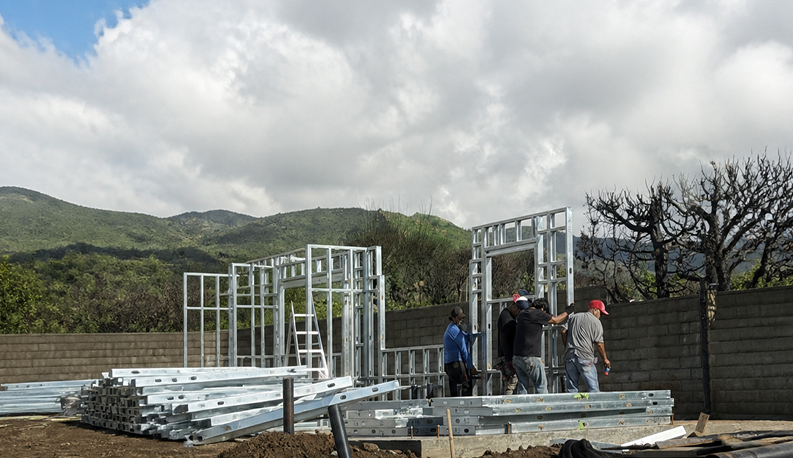
On headline cost per square meter, modern factory-built (MMC) homes and good traditional builds are broadly comparable in Ireland. The financial difference shows up in the risk-adjusted total. Factory manufacturing means the price is substantially fixed before work begins. The program is roughly half as long, halving finance and rental costs. The as-built energy performance reliably matches design, so an A-rated bill profile is guaranteed rather than hoped for. And there's no exposure to the weather delays and trade-availability gaps that stretch Irish site programs.
At Hapi Homes, we manufacture precision light-gauge steel panels for fully custom homes: a system engineered digitally, produced in the factory, and assembled on site in days. When clients compare our turnkey quotes against traditional tenders, the headline figures are usually similar; the difference is that ours is the number you'll actually pay, on a date you can plan around.
How should you set a build budget?
Start from total funds, not house size. Work backward: take your total budget, subtract site and purchase costs, subtract 25 percent for fees, connections, contributions, contingency and landscaping; what remains, divided by about €2,200 per sqm, is the house size to design. Designing the dream first and pricing it after is the classic route to heartbreak.
l
.png)
.png)